
Building an Internal World: Tips for Dissociative Systems

WHAT IS AN INTERNAL WORLD?

The "internal world" is a term used to describe the mental landscape where alters of a dissociative system live, communicate, or simply exist. While some survivors' internal spaces came to be organically as children - and remain fixed until today - others only discovered their utilitarian or emotionally rich value as adults trying to heal. This impressively beautiful achievement of the human mind isn't given nearly enough recognition or support, though. So, whether you’re brand new to this work, are looking to do some ‘remodeling,’ or realize you missed some vital steps along the way, there are countless ways to cultivate an internal world that's ideal for you! ALL of you!

While no system requires an internal world, and conditions like aphantasia may pose added barriers, there can be real advantages to having a space inside the mind to interact and collaborate with one another. It can also be one of the most exciting, creative, and FUN aspects of having a dissociative system! Hopefully, this guide will tackle some of your questions, provide some visual inspiration, and stir any internal chatter you've been lacking.

Feel free to bookmark or share this resource with others who may benefit, including mental health professionals. Internal spaces are given shockingly little attention or discussion clinically, even amongst trauma specialists. Given how integral they can be for the daily function, emotional bonding, and overall safety of a dissociative system, survivors deserve everything we have to offer.

Happy building!

Note: If you’d like some visual inspiration and a more interactive way of learning,
use the slideshow below. If you prefer text only, scroll to the list below.
 
  1. If this is a brand new journey, it’s okay to start very, very small.

    A single meeting room. A roundtable. A classroom, campsite, or simple home. You can branch out or expand upon these ideas later, but you also never have to if they’re working for you.


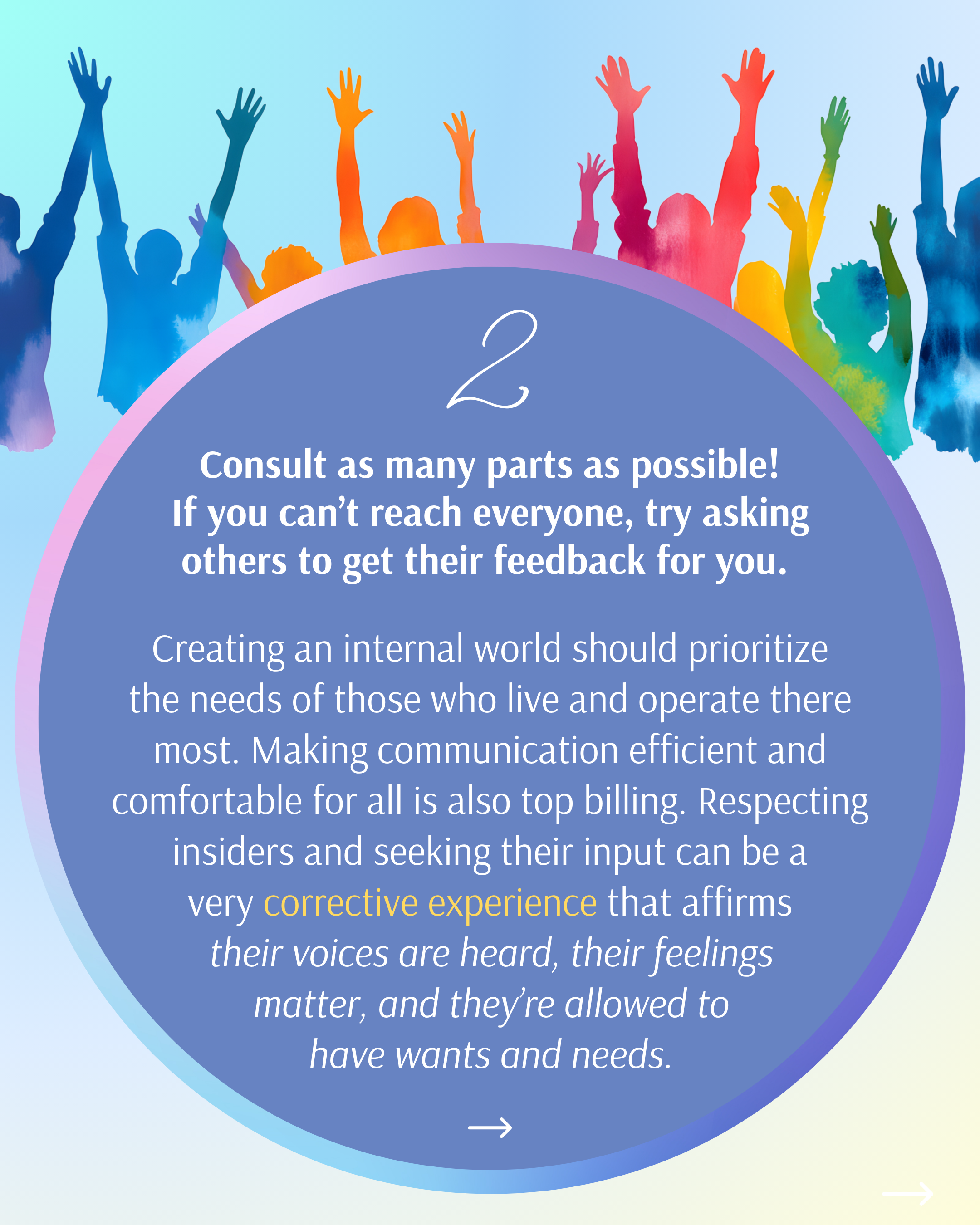
  2. Consult as many parts as possible! If you can’t reach everyone, try asking others to get their feedback for you.

    Creating an internal world should prioritize the needs of those who live and operate there most. Making communication efficient and comfortable for all is also top billing. Respecting insiders and seeking their input can be a very corrective experience that affirms their voices are heard, their feelings matter, and they’re allowed to have wants and needs.


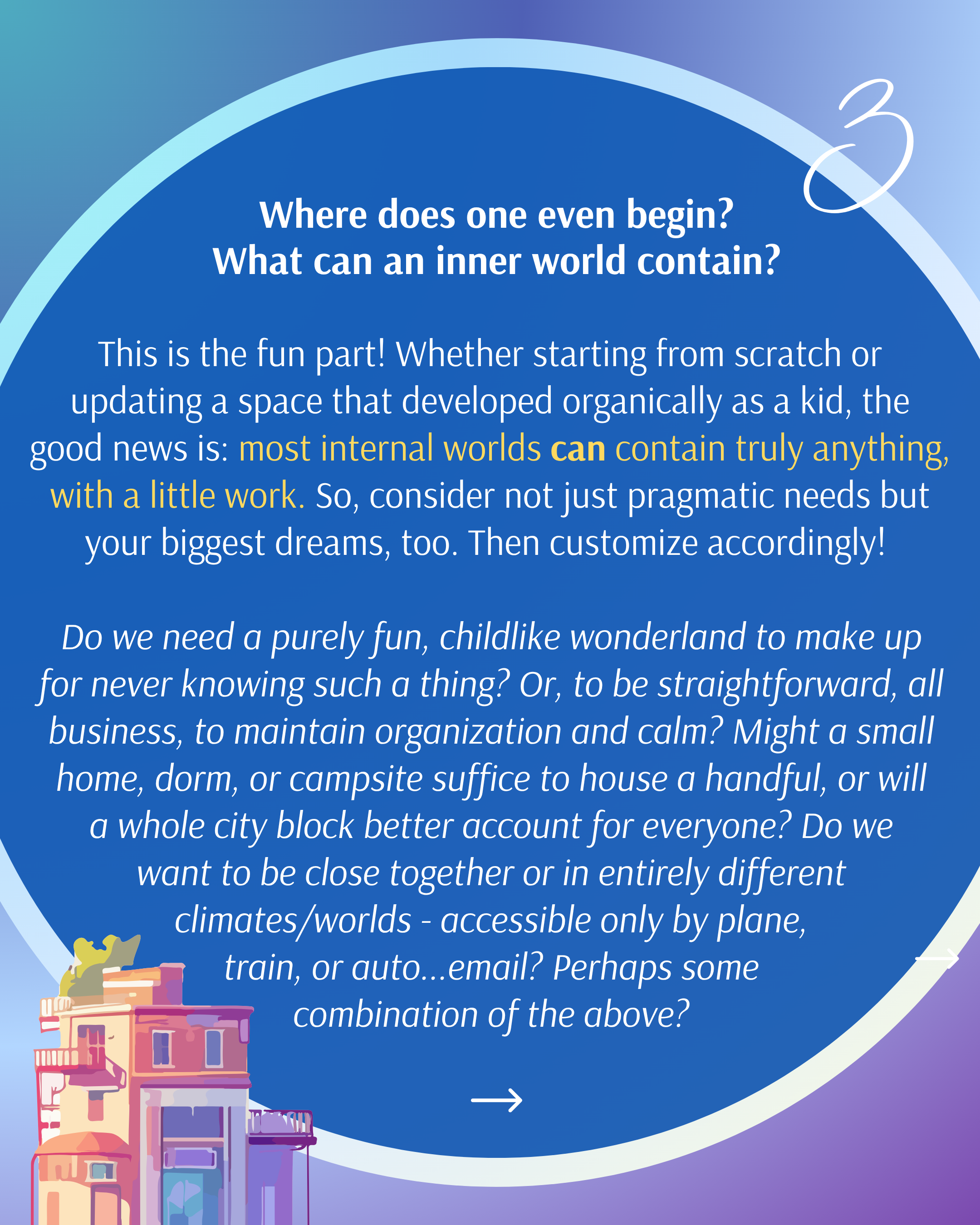
  3. Where does one even begin? What can an inner world contain?

    This is the fun part! Whether starting from scratch or updating a space that developed organically as a kid, the good news is: most internal worlds can contain truly anything, with a little work. So, consider not just pragmatic needs but your biggest dreams, too. Then customize accordingly!

    Do we need a purely fun, childlike wonderland to make up for never knowing such a thing? Or, to be straightforward, all business, to maintain organization and calm? Might a small home, dorm, or campsite suffice to house a handful, or will a whole city block better account for everyone? Do we want to be close together or in entirely different climates/worlds - accessible only by plane, train, or auto...email? Perhaps some combination of the above?


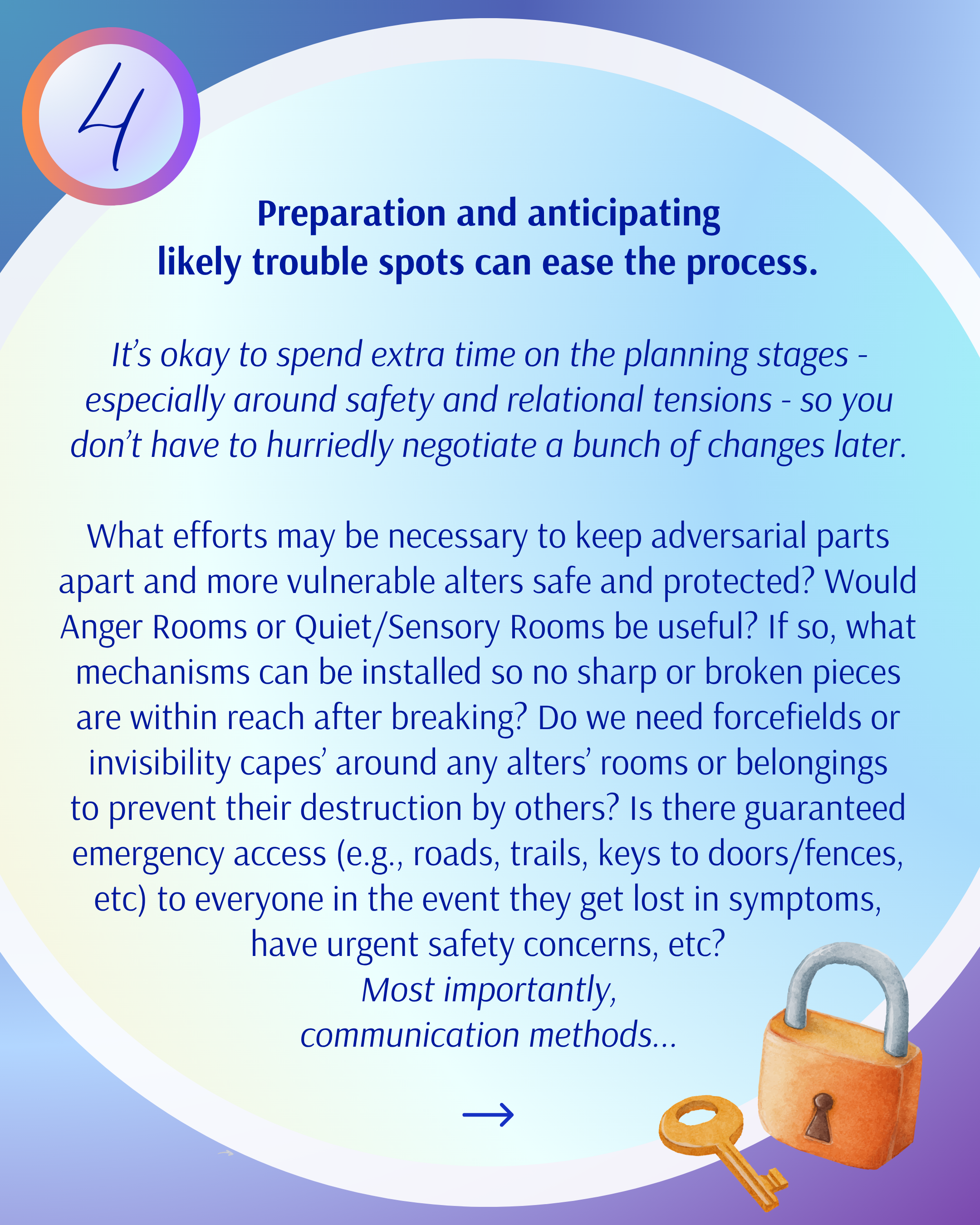
  4. Preparation and anticipating likely trouble spots can ease the process.

    It’s okay to spend extra time on the planning stages - especially around safety and relational tensions - so you don’t have to hurriedly negotiate a bunch of changes later.

    What efforts may be necessary to keep adversarial parts apart and more vulnerable alters safe and protected? Would Anger Rooms or Quiet/Sensory Rooms be useful? If so, what mechanisms can be installed so no sharp or broken pieces are within reach after breaking? Do we need forcefields or invisibility capes around any alters’ rooms or belongings to prevent their destruction by others? Is there guaranteed emergency access (e.g., roads, trails, keys to doors/fences, etc) to everyone in the event they get lost in symptoms, have urgent safety concerns, etc?

    Most importantly, communication methods...


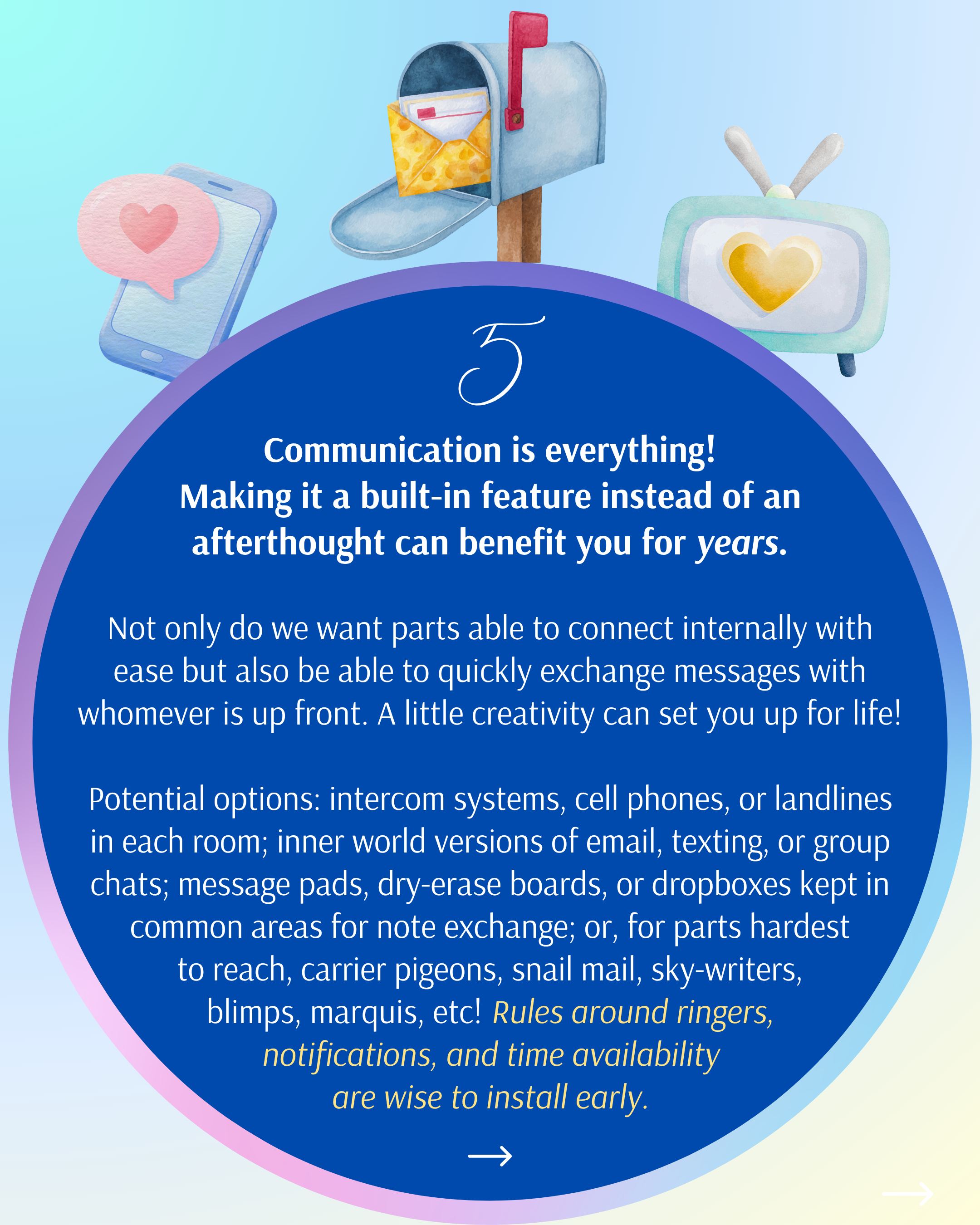
  5. Communication is everything! Making it a built-in feature instead of an afterthought can benefit you for years.

    Not only do we want parts able to connect internally with ease but also be able to quickly exchange messages with whomever is up front. A little creativity can set you up for life!

    Potential options: intercom systems, cell phones, or landlines in each room; inner world versions of email, texting, or group chats; message pads, dry-erase boards, or dropboxes kept in common areas for note exchange; or, for parts hardest to reach, carrier pigeons, snail mail, sky-writers, blimps, marquis, etc! Rules around ringers, notifications, and time availability are wise to install early.


  6. Seeking inspiration together can boost internal communication and get imaginations running wild!

    Invite parts to join you as you browse creative materials.
    Websites like deviantArt, Pinterest, and flickr hold a wealth of non-traditional living spaces – fantasy, high-tech, medieval, otherworldly, you name it. Home and garden, architecture, and landscaping magazines (that local doctors/dentists/salons can be eager to offload) often have noth practical and aspirational ideas. Googling for kid/teen bedrooms, treehouses, or tiny homes specifically can help young (or more ‘sheltered’) parts imagine their options - especially if their limited exposure to the world is making that tough.

    Save your faves and pull out anything you “just feel called to”. It may be someone’s quiet attempt to let you know they’re there.


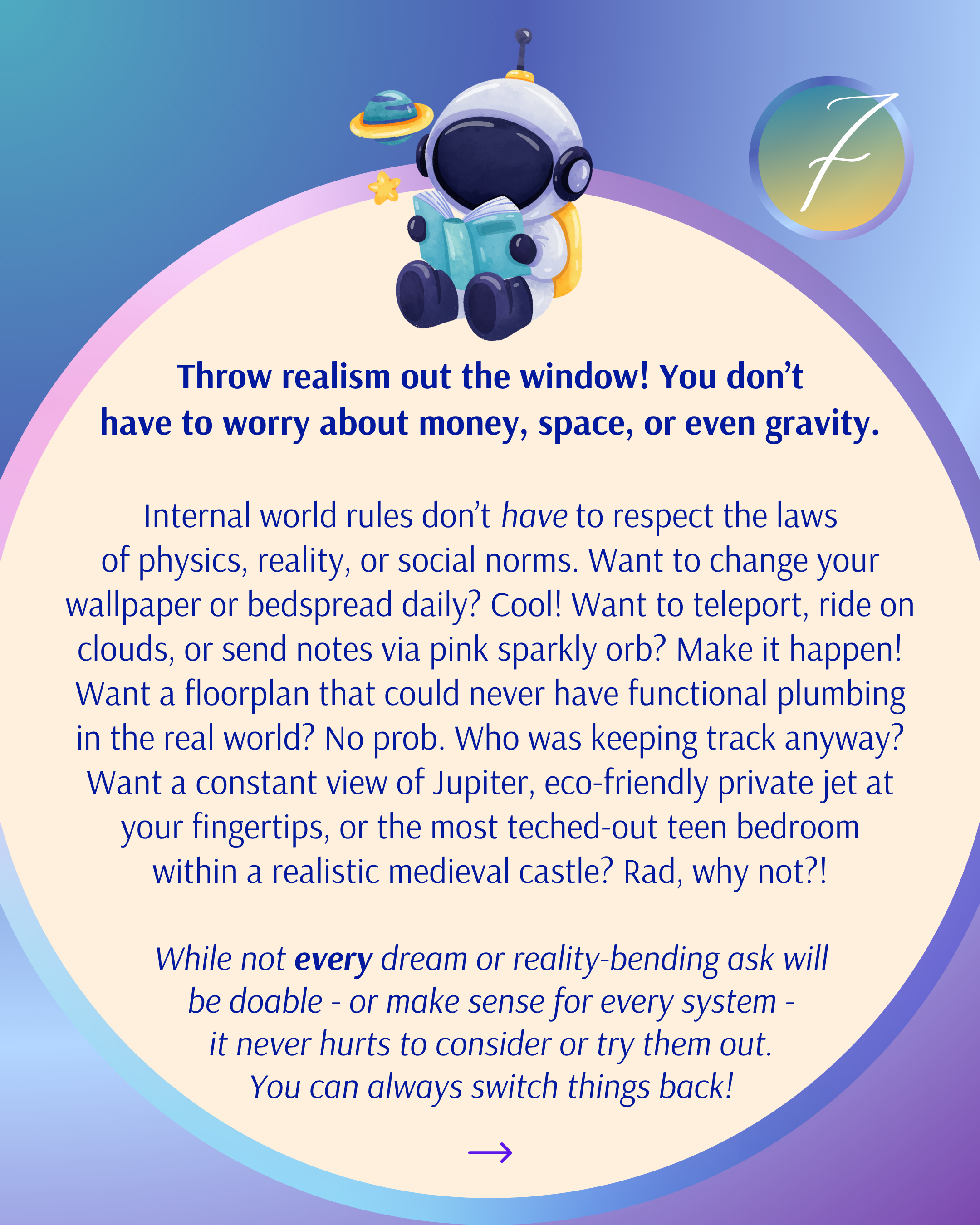
  7. Throw realism out the window! You don’t have to worry about money, space, or even gravity.

    Internal world rules don’t have to respect the laws of physics, reality, or social norms.
    Want to change your wallpaper or bedspread daily? Cool! Want to teleport, ride on clouds, or send notes via pink sparkly orb? Make it happen! Want a floorplan that could never have functional plumbing in the real world? No prob. Who was keeping track anyway? Want a constant view of Jupiter, eco-friendly private jet at your fingertips, or the most teched-out teen bedroom within a realistic medieval castle? Rad, why not?!

    While not every dream or reality-bending ask will be doable - or make sense for every system - it never hurts to consider or try them out. You can always switch things back!


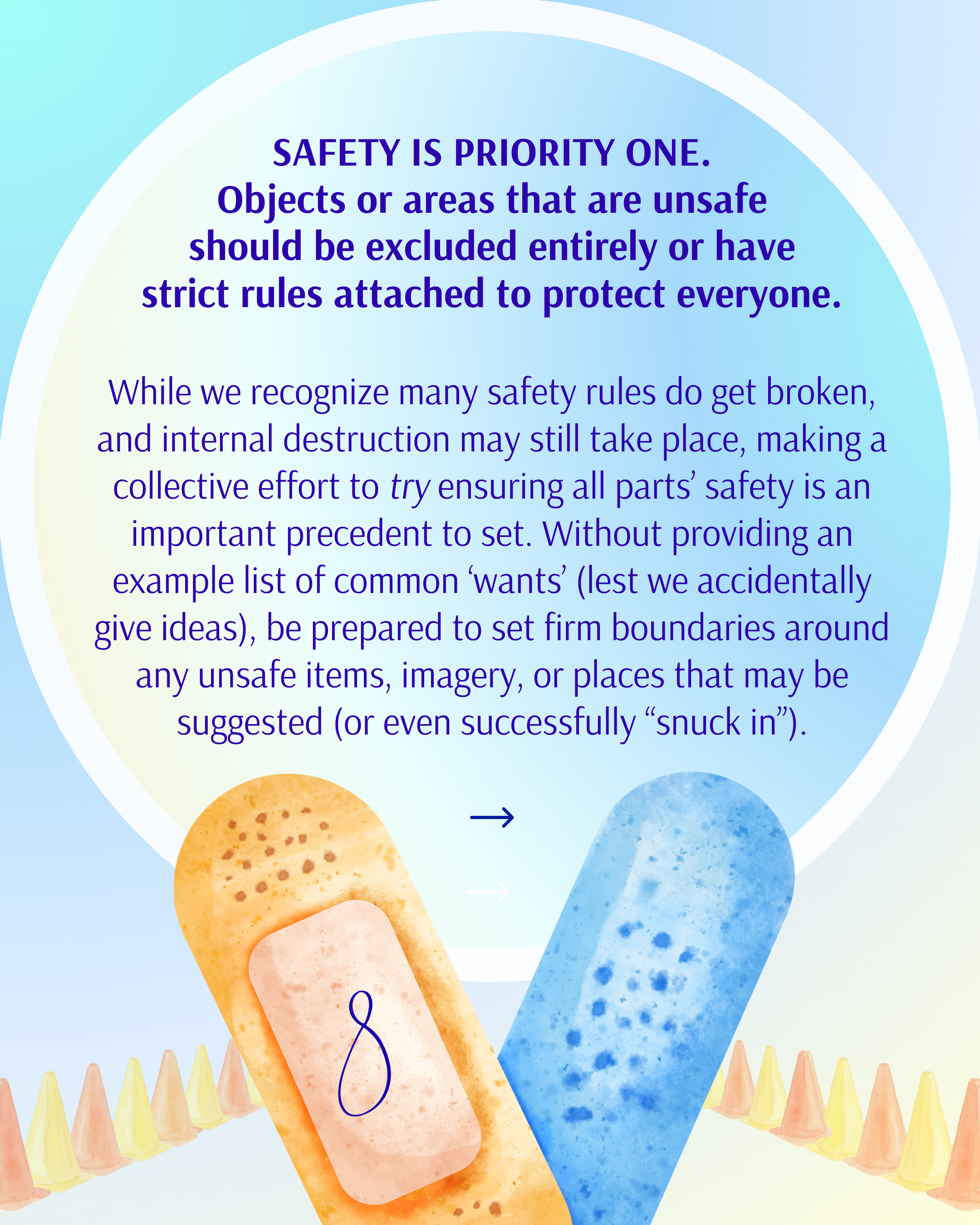
  8. SAFETY IS PRIORITY ONE. Objects or areas that are unsafe should be excluded entirely or have strict rules attached to protect everyone.

    While we recognize many safety rules do get broken, and internal destruction may still take place, making a collective effort to try ensuring all parts’ safety is an important precedent to set. Without providing an example list of common ‘wants’ (lest we accidentally give ideas), be prepared to set firm boundaries around any unsafe items, imagery, or places that may be suggested (or even successfully “snuck in”).


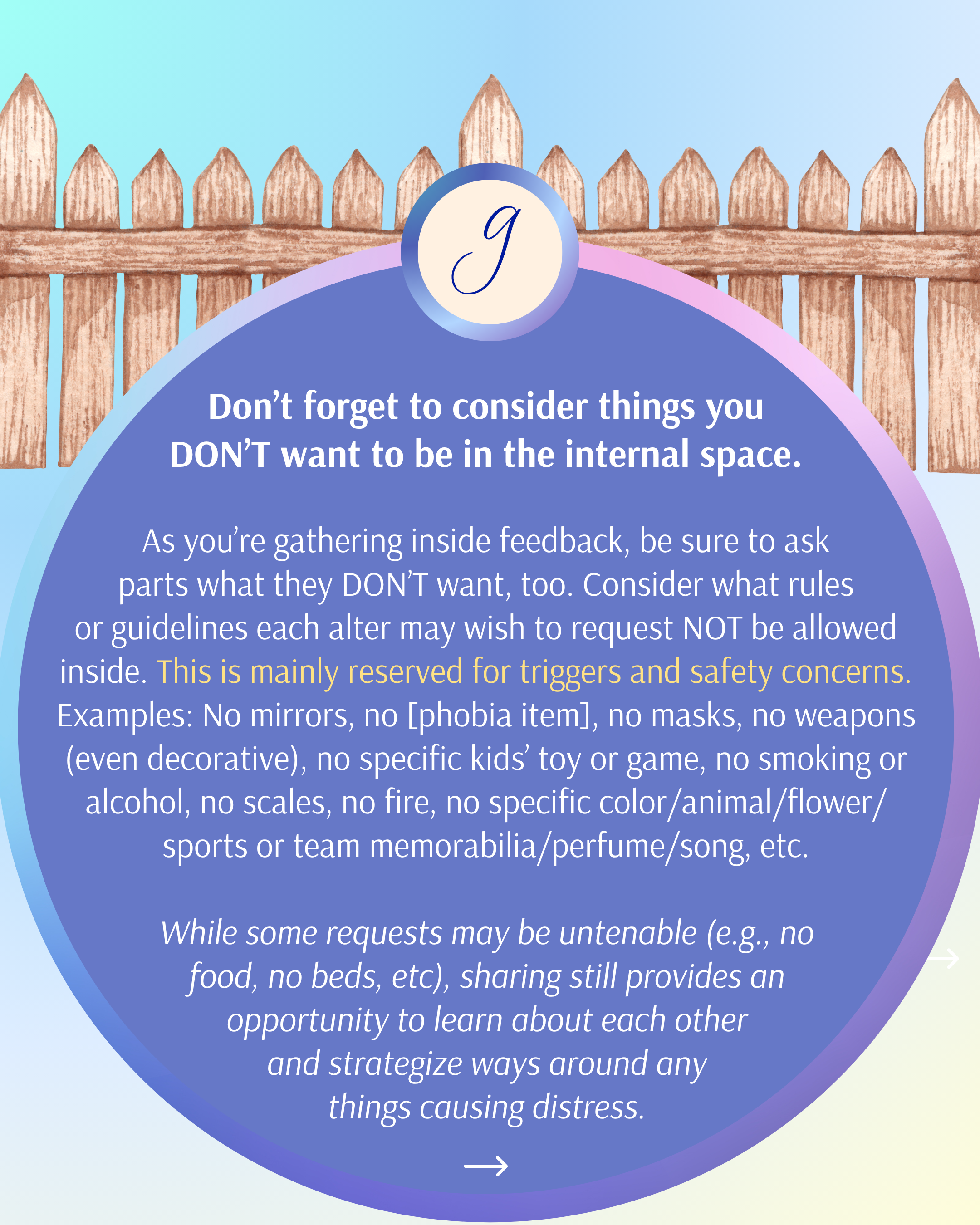
  9. Don’t forget to consider things you DON’T want to be in the internal space.

    As you’re gathering inside feedback, be sure to ask parts what they DON’T want, too. Consider what rules or guidelines each alter may wish to request NOT be allowed inside. This is mainly reserved for triggers and safety concerns. Examples may include: No mirrors, no [phobia item], no masks, no weapons (even decorative), no specific kids’ toy or game, no smoking or alcohol, no scales, no fire, no specific color/animal/flower/sports or team memorabilia/perfume/song, etc.

    While some requests may be untenable (e.g., no food, no beds, etc), sharing still provides an opportunity to learn about each other and strategize ways around any things causing distress.


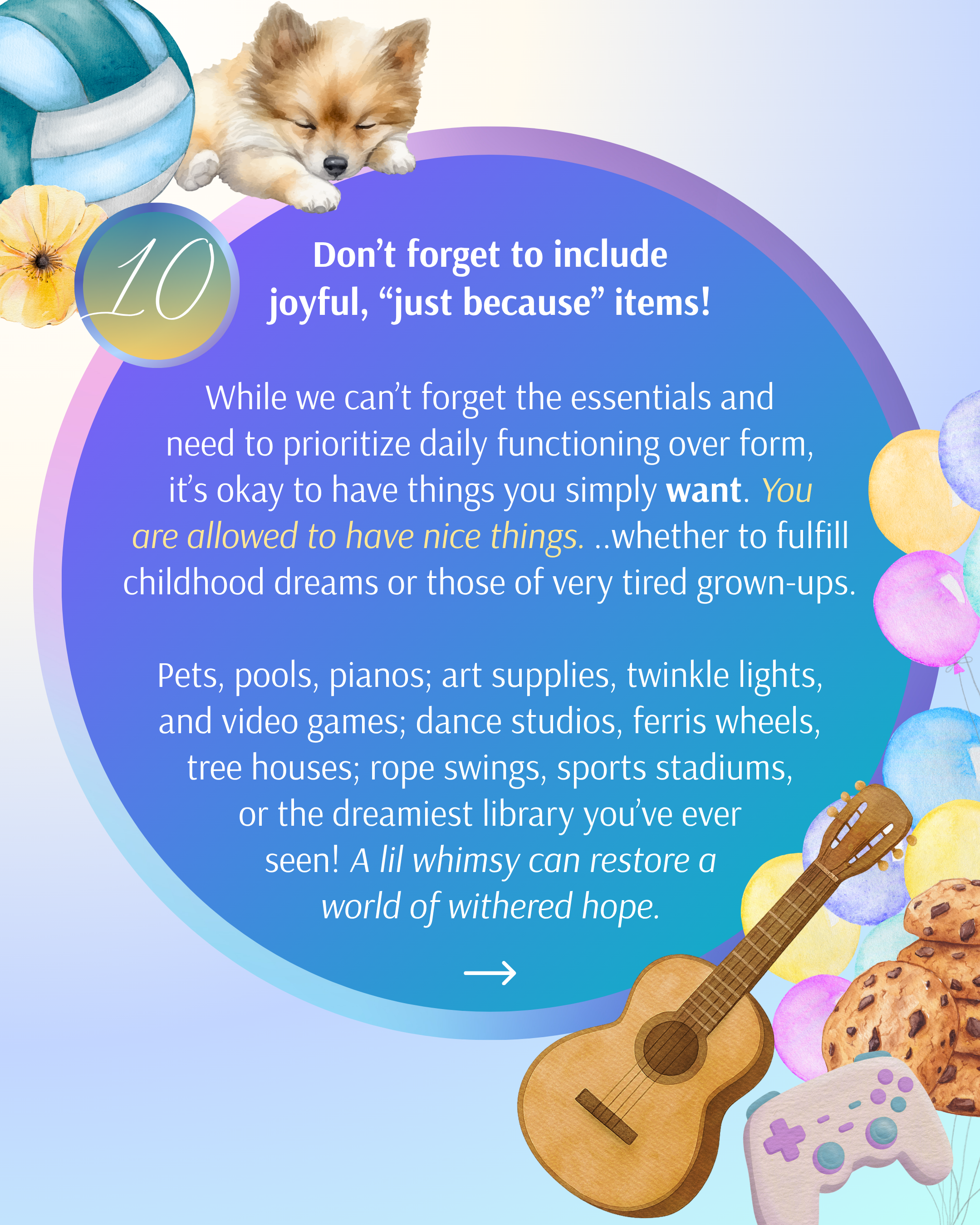
  10. Don’t forget to include joyful, “just because” items!

    While we can’t forget the essentials and need to prioritize daily functioning over form, it’s okay to have things you simply want. You are allowed to have nice things. ...whether to fulfill childhood dreams or those of very tired grown-ups.

    Pets, pools, pianos; art supplies, twinkle lights, and video games; dance studios, ferris wheels, tree houses; rope swings, sports stadiums, or the dreamiest library you’ve ever seen! A lil whimsy can restore a world of withered hope.


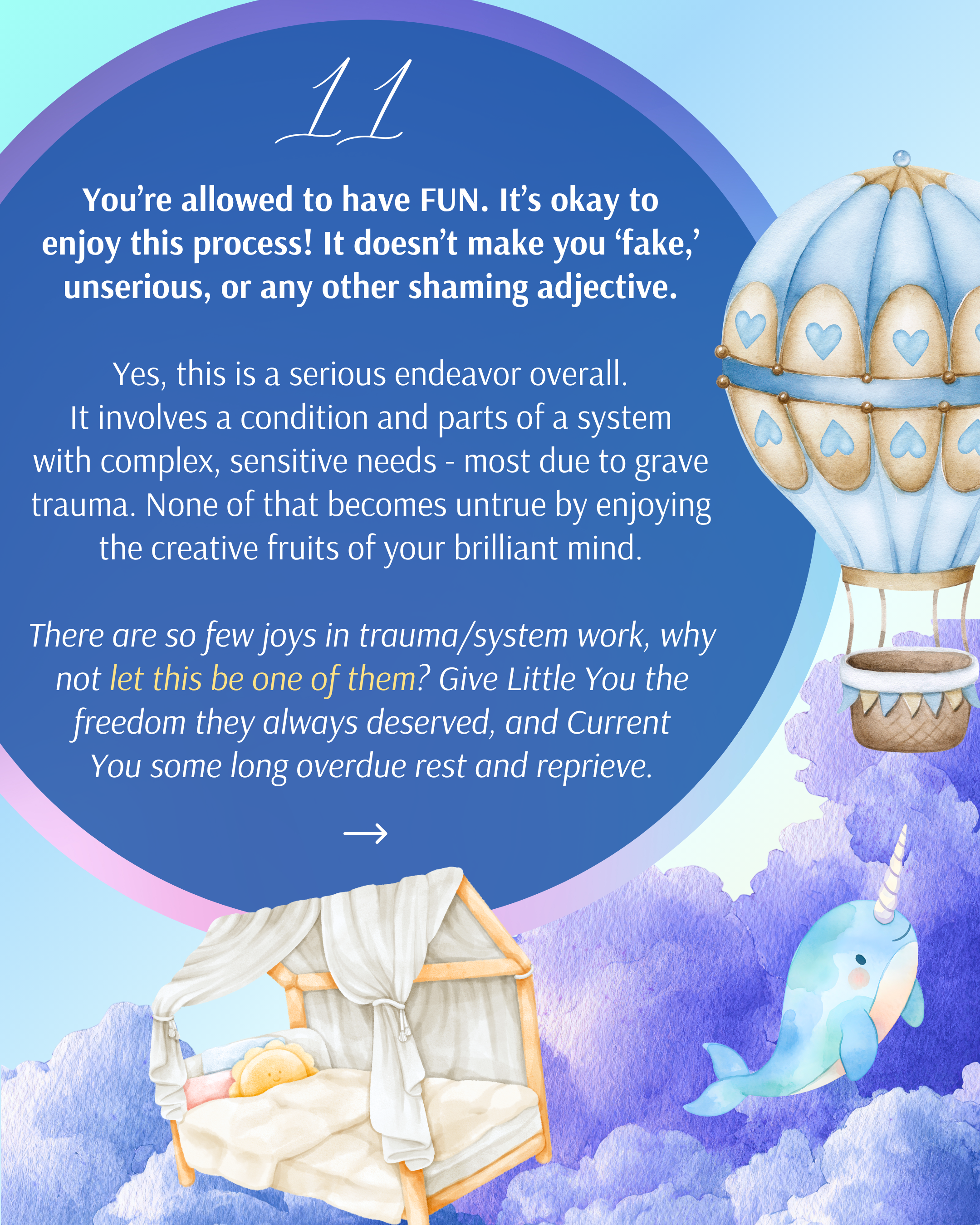
  11. You’re allowed to have FUN. It’s okay to enjoy this process! It doesn’t make you ‘fake,’ unserious, or any other shaming adjective.

    Yes, this is a serious endeavor overall.
    It involves a condition and parts of a system with complex, sensitive needs - most due to grave trauma. None of that becomes untrue by enjoying the creative fruits of your brilliant mind.

    There are so few joys in trauma/system work, why not let this be one of them? Give Little You the freedom they always deserved, and Current You some long overdue rest and reprieve.


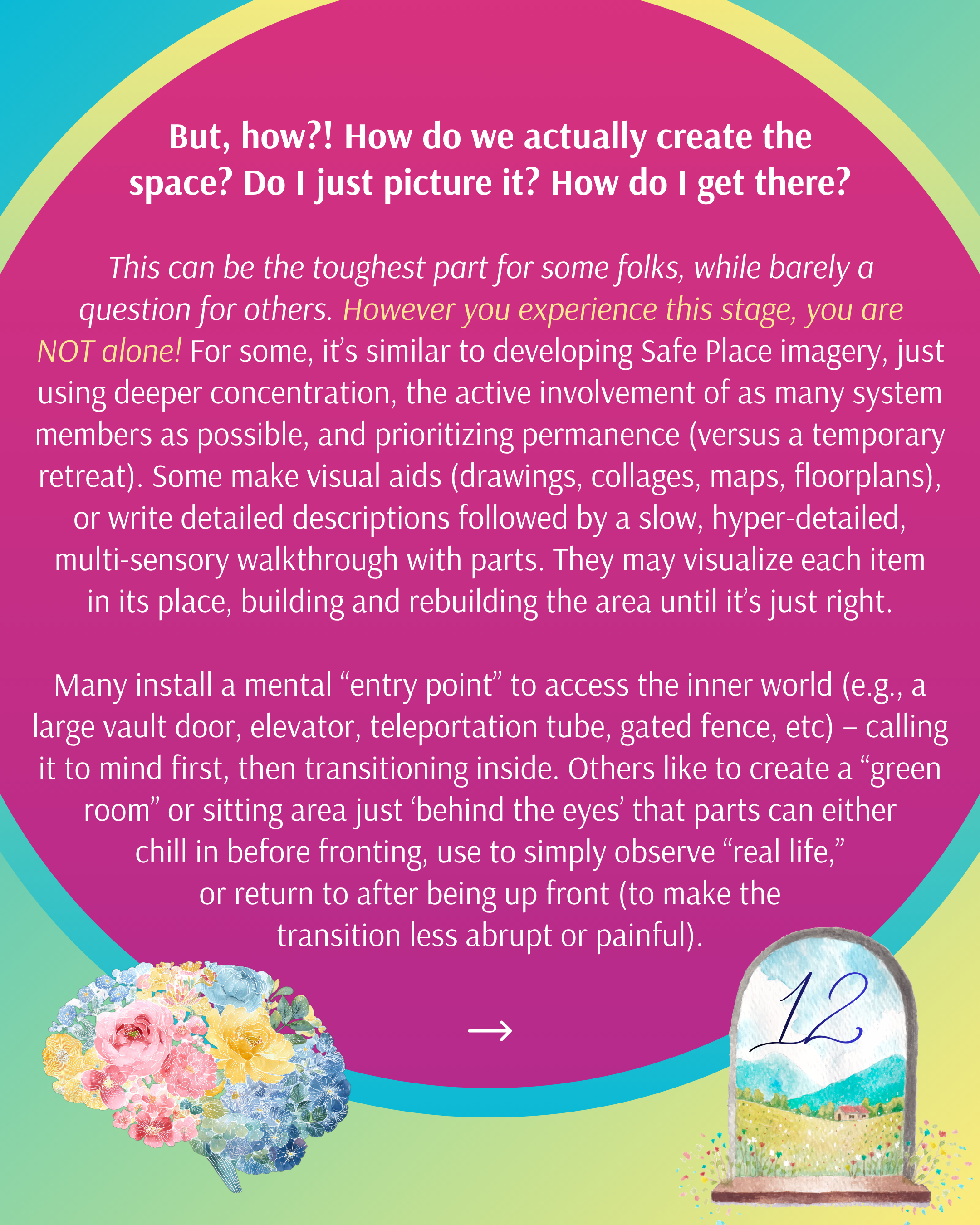
  12. But, how?! How do we actually create the space? Do I just picture it? How do I get there?

    This can be the toughest part for some folks, while barely a question for others. However you experience this stage, you are NOT alone!
    For some, it’s similar to developing Safe Place imagery, just using deeper concentration, the active involvement of as many system members as possible, and prioritizing permanence (versus a temporary retreat). Some make visual aids (drawings, collages, maps, floorplans), or write detailed descriptions followed by a slow, hyper-detailed, multi-sensory walkthrough with parts. They may visualize each item in its place, building and rebuilding the area until it’s just right.

    Many install a mental “entry point” to access the inner world (e.g., a large vault door, elevator, teleportation tube, gated fence, etc) – calling it to mind first, then transitioning inside. Others like to create a “green room” or sitting area just ‘behind the eyes’ that parts can either chill in before fronting, use to simply observe “real life,” or return to after being up front (to make the transition less abrupt or painful).


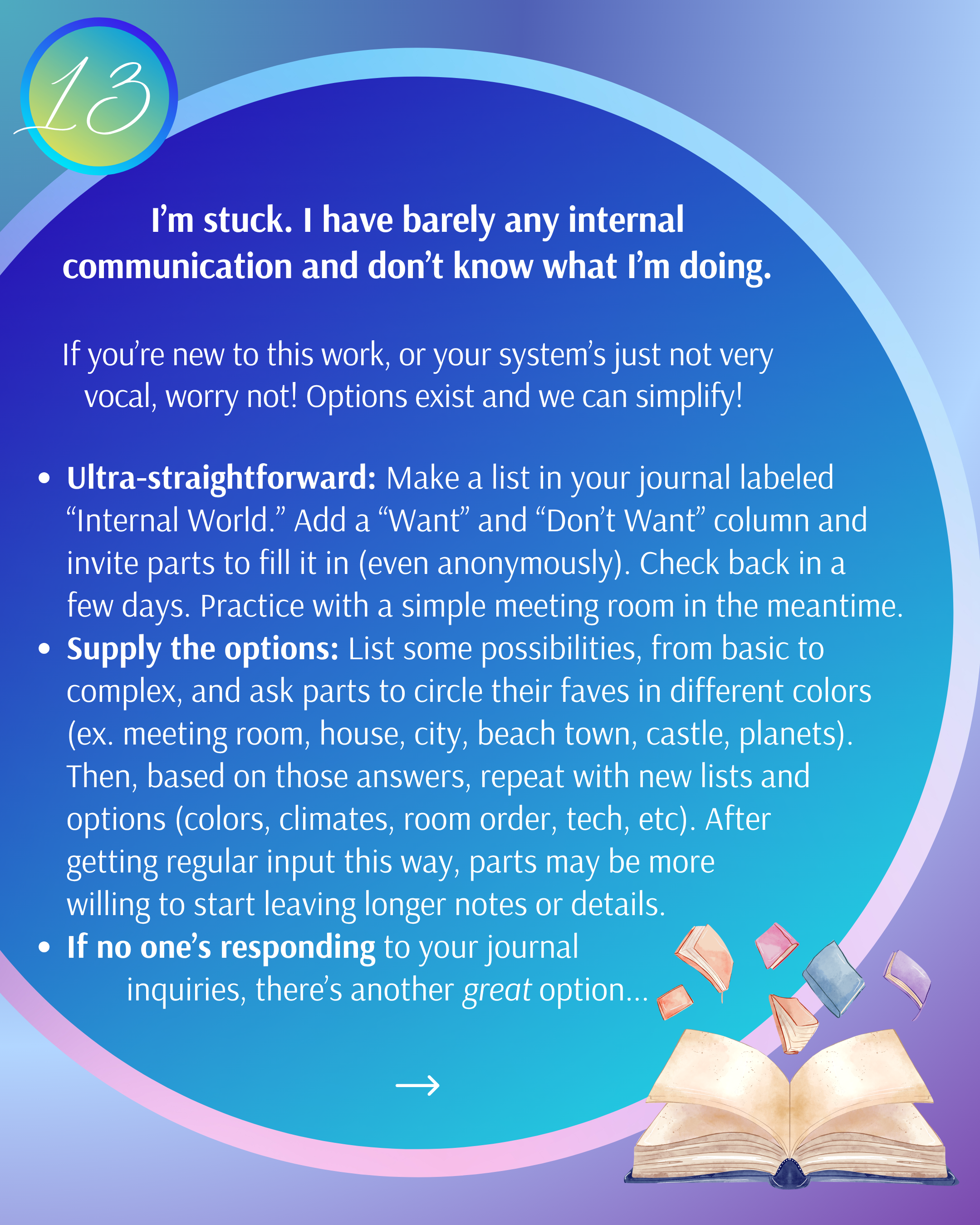
  13. I’m stuck. I have barely any internal communication and don’t know what I’m doing.

    If you’re new to this work, or your system’s just not very vocal, worry not! Options exist and we can simplify!

    • Ultra-straightforward: Make a list in your journal labeled “Internal World.” Add a “Want” and “Don’t Want” column and invite parts to fill it in (even anonymously). Check back in a few days. Practice with a simple meeting room in the meantime.

    • Supply the options: List some possibilities, from basic to complex, and ask parts to circle their faves in different colors (ex. meeting room, house, city, beach town, castle, planets). Then, based on those answers, repeat with new lists and options (colors, climates, room order, tech, etc). After getting regular input this way, parts may be more willing to start leaving longer notes or details.

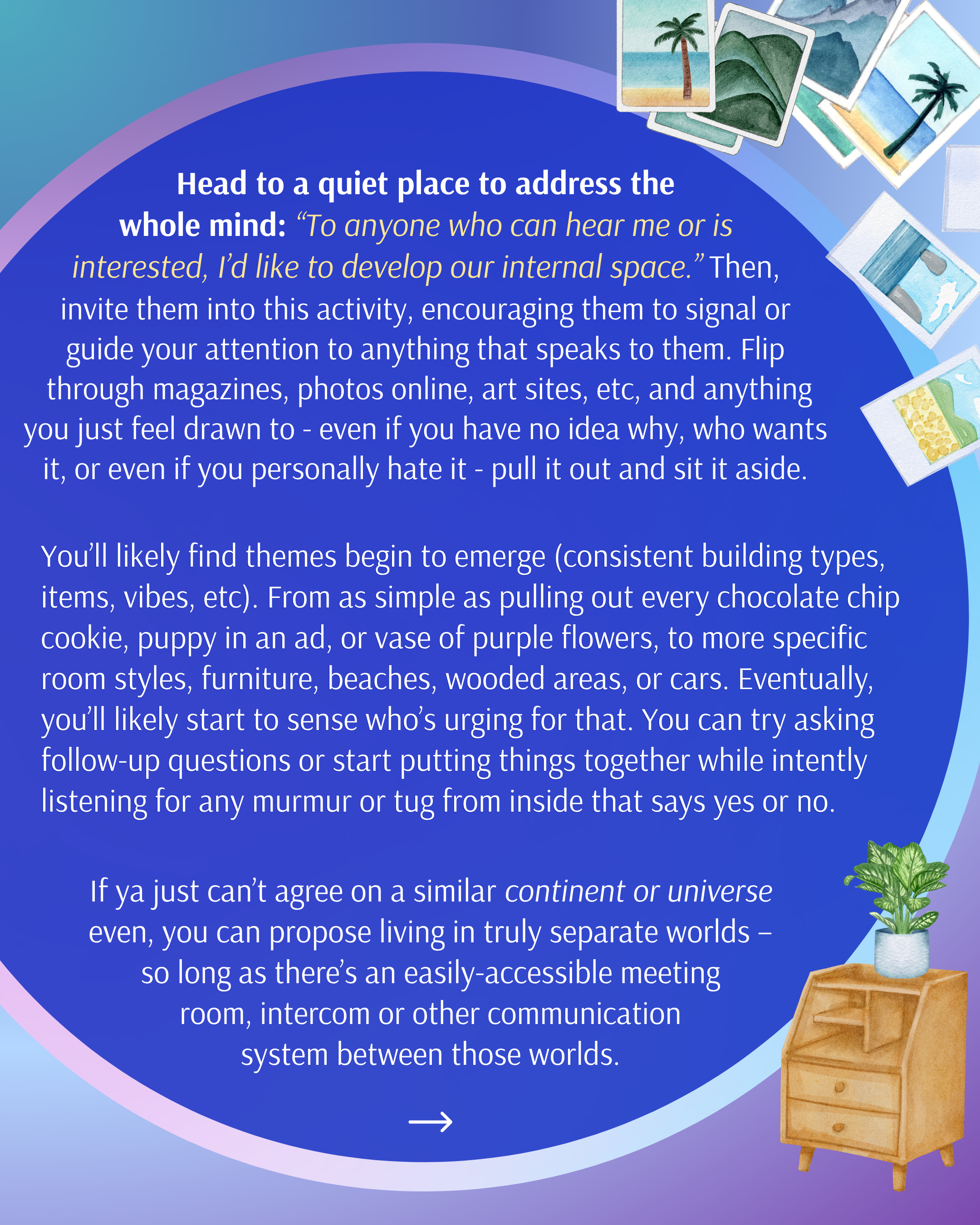
    • If no one’s responding to your journal inquiries: Head to a quiet place to address the whole mind: “To anyone who can hear me or is interested, I’d like to develop our internal space.” Then, invite them into this activity, encouraging them to signal or guide your attention to anything that speaks to them. Flip through magazines, photos online, art sites, etc, and anything you just feel drawn to - even if you have no idea why, who wants it, or even if you personally hate it - pull it out and sit it aside.

      You’ll likely find themes begin to emerge (consistent building types, items, vibes, etc). From as simple as pulling out every chocolate chip cookie, puppy in an ad, or vase of purple flowers, to more specific room styles, furniture, beaches, wooded areas, or cars. Eventually, you’ll likely start to sense who’s urging for that. You can try asking follow-up questions or start putting things together while intently listening for any murmur or tug from inside that says yes or no.

      If ya just can’t agree on a similar continent or universe even, you can propose living in truly separate worlds – so long as there’s an easily-accessible meeting room, intercom or other communication system between those worlds.


**Post note: To our survivors of organized abuse and/or those who’ve had their internal worlds made for them - we encourage you to tread lightly when trying to change the internal world. Go slowly and ask for internal input before making moves, as some modifications can have unintended consequences. There are ways to work through this, and we hope you have a supportive clinician to help you navigate this safely. Some systems will be able to modify most anything without issue, while others experience friction at every step. If this message doesn’t apply or makes no sense to you, don’t worry! Just skip it and move along :)


Remember: There is no one way, no “correct,” and no perfect way to have an internal world. It can be a project always in flux. Every system is unique and has their own set of explicit needs, abilities, and ways of functioning. Some will find their internal landscape feels more ‘fixed’ or ‘unmovable’, while others can change it at will. Some may struggle with it being regularly destroyed while others just might be unable to have one altogether (be it from disinterest, not finding it helpful, or it just not “sticking”). There is no one way to have a dissociative mind.

Troubleshooting with other systems may be extremely beneficial, but try not to compare too much. Every mind is unique and should aim for what’s most helpful to their survival, internal harmony, and happiness. What is something you wish you'd known or implemented sooner when it comes to internal worlds?



MORE POSTS YOU MAY FIND HELPFUL:

  ✧  Grounding 101: 101 Grounding Techniques
  ✧  Flashbacks 101: 4 Tools to Cope with Flashbacks
Self-Care 101: 101 Self-Care Tools
✧  Distraction 101: 101 Distraction Tools
  ✧  Nighttime 101 and Nighttime 201Sleep Strategies for Complex PTSD
Color Breathing 101: How to Calm Overwhelming Emotions and Physical Pain
  ✧  Imagery 101Healing Pool and Healing Light
  ✧  Modulation 101: Using Dials to Modulate Intrusive Mental Health Symptoms
  ✧  DID MythsDispelling Common Misconceptions about Dissociative Identity Disorder
 ✧  Managing Unmanaged Dissociation: 15-minute Checksheets
 
  ❖  
Article Index  ❖

 
FIND US ON SOCIAL MEDIA:

  ✦  Facebook: Beauty After Bruises // Therapy Box Project
  ✦  Instagram: Beauty After Bruises // Therapy Box Project
  ✦  Threads
  ✦  Twitter/X
Managing Unmanaged Dissociation: 15-minute Checksheet

This image illustrates various aspects contributing to holistic well-being, often associated with a comprehensive approach to mental health and personal development.
 

Regaining Control of Unmanaged Dissociation

Dissociation is a beautiful, intelligent, and highly adaptive skill. It makes everything from the painfully mundane to the horrifically traumatic more survivable. It also gives us the gift of diluting physical pain, holding back overwhelming emotions, compartmentalizing daily stressors and difficult memories, and zooming out to gain different perspectives. When dissociation is unmanaged, however, its consequences can range anywhere from frustrating to life-limiting, scary, or even dangerous. Some of those experiences can include:

  • frequently losing minutes to hours of the day – possibly stuck in flashbacks, performing self-destructive or compulsive behaviors, zoned out, or doing other atypical actions,

  • unwanted switching between alters in a DID/OSDD system – possibly having no way to be filled in on what was missed later and/or switch back,

  • missing important events/meetings/moments due to not being oriented to the correct year, month, or day,

  • rapid-cycle switching between multiple parts of a DID/OSDD system (having no control over who is forward),

  • extended spells of non-responsive zoning out, becoming “locked in,” or even appearing ‘catatonic,’ for potentially hours,

  • unknowingly engaging in self-harmful or unlawful behaviors, without recollection or ability to regain control over the mind/body,

  • becoming so disoriented from the current time/place they’re unable to find their way home, to work, or another important location – potentially so unaware of the present year, they don’t know about GPS, smartphones to call for help, or who in their life today they should even call for help,

  • living life so detached - or “on autopilot” - for long enough that derealization leads to significant existential panic/paranoia (e.g. fears of truly not being real, alive, or having ever been in control of their body/life/etc, etc),

  • uncontrolled switches to child alters in public or behind the wheel, with no way to negotiate a switch back to a safe, more mature part,

  • having chronic, unexplained moments of not being present whilst driving, cooking, showering, out in public, or other very dangerous situations,

  • or many other disabling experiences.

For all these reasons and more, employing every last option to regain control over one’s symptoms may become a welcome solution. If learning about, and diligently using, your very best grounding tools isn’t enough, you’ve done journaling and internal communication with parts, tried modulation and containment skills for intrusive symptoms, and even asked for external supports to help keep you present, it may be time to turn to a higher-level intervention. Welcome in a 15-minute checksheet! You can download it here (to print or fill in on your devices).

What is a 15-minute checksheet?

Conveniently, it’s exactly as it sounds! It’s a daily tracking sheet for folks to check-in every 15 minutes - jotting down just a few pieces of information like, where are ya, who are ya (DID/OSDD specifically), how grounded are you, what are you feeling, and what are you up to. While 15 minutes may sound incredibly intimidating, or even unreasonable, keeping track of things in this much detail can provide vital information that we just can’t get when unmanaged dissociation is stealing this much of our memory, sense of self-awareness, cognitive power, and our best problem-solving abilities.

This tool encourages us to pause, briefly connect with our internal experience, and jot it down somewhere for safe-keeping until we’re ready to look at it in the bigger picture. It takes the required brainpower out of it and helps us spot trends and patterns in the areas we’re getting hung up - ones we never could have noticed on our own. …at least, not when our dissociation’s this bad. Answering questions like:

Is there a certain activity I’m doing that keeps setting off this dissociation?
An emotion I’m feeling that’s prompting these huge gaps on the page every time?
Is there someone in my life who’s making me get extra spacey or begin rapidly switching?
An actual location or room in my house that’s fueling the fire?
Does it only happen at my job, at a certain relative’s house, or once I’m in my car?
Is it only in the mornings, right before bedtime, or some other oddly specific time?
Is my sheet completely blank from the time I make dinner onward? …why is that?
Do I only start seeing my grounding numbers tank after taking this one medication? Is it sedating me and/or do I need to talk to my doctor about it?
Do we have huge holes in the sheet right after one particular alter comes out? How can we work on that with them together?
…and so much more.


now comes the biggest question: EVERY 15 MINUTES, really?!

Yes, we really do want to encourage you to set a little alarm and at least try doing so for as long as you can stand it. As this is often an intervention for folks teetering on the edge of needing a Higher Level of Care (e.g. Intensive Outpatient, Partial Hospitalization, or Inpatient Care), the minute frequency is quite high. But, whether you utilize this tool in those 15-minute increments or spread it out to meet a less critical need, there is no shortage of valuable information to be gathered from a tool like this. Customization is key!

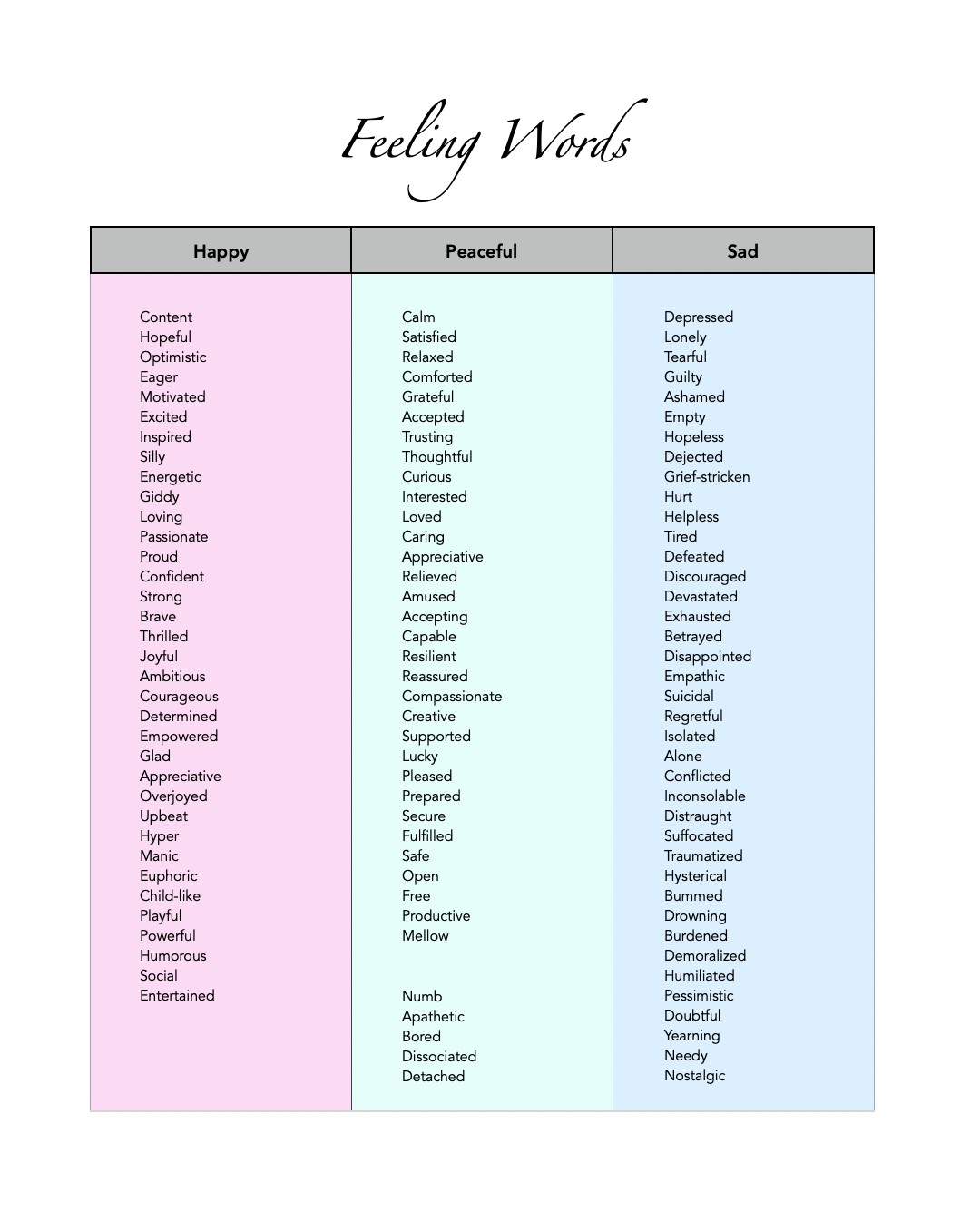
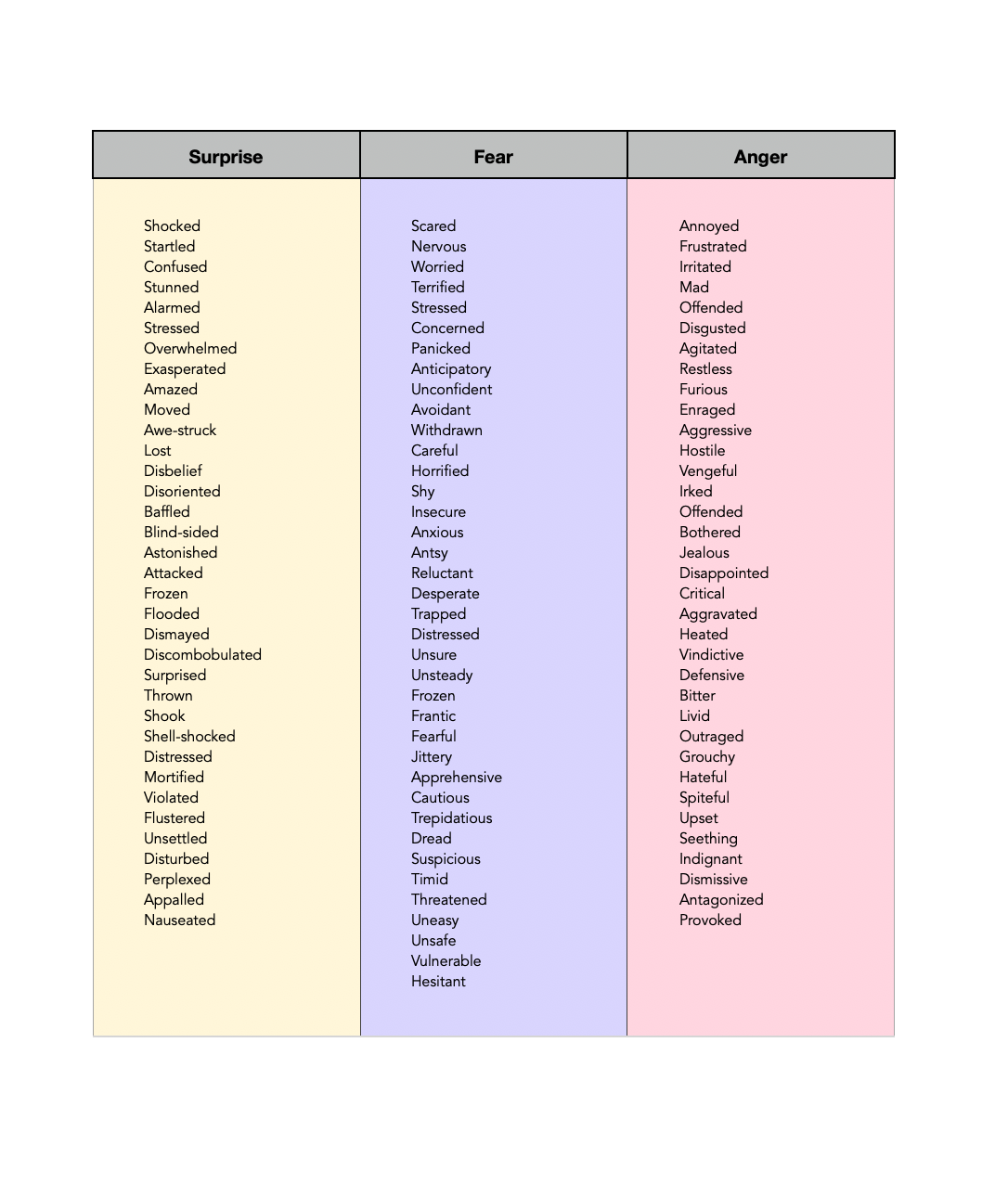
There are, however, some places folks can get a bit tripped up, so we wanted to include a section just for you! We also made sure to keep it with the downloadable PDF version (which also has a detailed List of Emotions, as that’s something many survivors of complex trauma can struggle with). This way you’ll always have it with you. No need to return or remember this page link! We know this is a tough time and you don’t need any added barriers.

Here are things that may help you along the way:

  • Blanks are okay - good even!
    You aren’t expected to make every check-in time. If you could do that already, you wouldn’t be doing this sheet :) And, gaps give us information. That information will help us develop more effective solutions to combat your symptoms. Do your best to fill as many as you can, but consider a sheet with chunks missing a success!

  • No back-filling.
    It may be tempting to go back and fill in time slots you can reasonably recall. Try not to do this. Forgetting to jot things down still lets us know you weren’t 100% grounded or in a clear enough mind to remember to do the task (i.e. increase in ADHD symptoms, etc.). That’s more information for us! Unless you physically couldn’t write it down at the time (e.g. driving, doing a work task, making dinner, showering, etc), try not to backfill. If you do think it would be helpful to still have the other info, just notate somewhere (*) that these are retroactive answers. That will tell us a bit more about the quality of those assessments, in addition to your degree of present-ness at that time.

  • Don’t panic, this task won’t last forever!
    Just a handful of days is often enough to gather a lot of helpful information. If you can simply commit to giving your best effort those few days, you’ll do yourself a huge solid and be that much closer to getting your life back!

  • Set yourself some timers if you need.
    Nothing wrong with using all tools available to you to keep you on-task! Timers can also be easier than alarms since you can simply hit reset for a new 15-minute interval instead of having to create new clock times every quarter. If you’re getting startled or sensorily overwhelmed by all the timers, try a simple vibration alert instead.

  • Call on parts inside to help!
    Still struggling to remember? If you have parts inside, try assigning someone inside the job of watching the clock and reminding you when it’s time to check in. Parts like to feel important and valued; this can be a unifying experience and a good exercise in team building/bonding for systems.

  • Too overwhelmed or wanting to give up?
    If every 15 minutes really is just too much, try spacing it out to every half-hour. Or, conversely, start by checking in each hour, then tomorrow every 30 minutes, and the next day every 15. We’re just in search of helpful information, not aiming to flood, frustrate, or panic you. Some info is always better than none at all!

  • Still too overwhelming?
    Pick a chunk of hours in the day that you tend to lose the most time or struggle with other symptoms most prominently. Extend an hour in either direction and commit to just checking in as much as you can during that timeframe.

  • Making it to every check-in?
    Awesome! You’re doing so well with your grounding that you can now try spacing things out a good bit. Let’s see if things continue to hold without as much structure. If you start noticing more gaps without these consistent check-ins, we can re-evaluate and see if returning to 15 minutes would be beneficial. Or, you may discover that these are positive gaps due to living an active, grounded, well-lived life!


final thoughts

There is so much we can glean from such a meticulous tracking tool—even if your dissociation isn’t terribly unmanaged. Simply noticing and correctly labeling our emotions, observing patterns and catching where we’re spending too much of our time, discovering relationships or activities that may be harder on our health than we realized, becoming aware of or establishing communication with new parts inside, or even finding out that you’re more in control of your life than you realized — these all have tremendous benefits! And, you deserve to reap them. You deserve to live a life with full authority, agency, and confidence. May you reclaim exactly that if it’d been lost, or even better, unearth it for the very first time!

If, at any point throughout this exercise, you do discover yourself feeling particularly ungrounded, emotionally dysregulated, or more broadly overwhelmed, we encourage you to bookmark some of these pages for supportive symptom management: Grounding 101, Modulation 101, Color Breathing, and/or Self-Care 101. There, you’ll find hundreds (literally) of techniques to help you re-stabilize. Additional symptom management resources are listed at the bottom of this article!

We will be thinking of you and are here to answer any of your questions. As a reminder, you can download this fillable PDF to print or use on your devices. For therapists, you are welcome to offer this to your clients in either form. Healing tools should be for everyone.


MORE POSTS YOU MAY FIND HELPFUL:

  ✧  Grounding 101: 101 Grounding Techniques
  ✧  Flashbacks 101: 4 Tools to Cope with Flashbacks
Self-Care 101: 101 Self-Care Tools
✧  Distraction 101: 101 Distraction Tools
  ✧  Nighttime 101 and Nighttime 201Sleep Strategies for Complex PTSD
Color Breathing 101: How to Calm Overwhelming Emotions and Physical Pain
  ✧  Imagery 101Healing Pool and Healing Light
  ✧  Modulation 101: Using Dials to Modulate Intrusive Mental Health Symptoms
  ✧  DID MythsDispelling Common Misconceptions about Dissociative Identity Disorder
 
  ❖  
Article Index  ❖

 
FIND US ON SOCIAL MEDIA:

  ✦  Facebook: Beauty After Bruises // Therapy Box Project
  ✦  Instagram: Beauty After Bruises // Therapy Box Project
  ✦  Threads
  ✦  Twitter/X

In Times of Global Crisis: Caring for Yourself

The image depicts a person with a distressed expression, holding their hand to their face, while a heart-shaped representation of Earth is shown next to them.


Only two short weeks into this new year and we know it’s been a tumultuous whirlwind of tragedy, stress, uncertainty, and even some real terror. From attacks, to blizzards, to the unconscionable California wildfires, to the kinds of violence whose published words alone would prevent these resources from getting to you – these times of crisis can make even steadiest of us feel frenzied, panicked, and lost. …overwhelmed to the point of disorientation, hopelessness, or shutdown.

For survivors of complex trauma, these heightened responses to others’ suffering, or their very own real danger, can swell far beyond one's window of tolerance. And, for survivors of organized or spiritual abuse, things can even take on a truly surreal or existential quality that's difficult to subdue. No one deserves to suffer in this way. That includes you. So. How do we make it through these times of extreme chaos and disorder? How do we keep both our heads above water and our feet on the ground? How can we ensure our own wellbeing if we’re to have any hope of helping others ensure their safety?

While we recognize anything less than crisis management and relief care is unlikely to be of much help to those in immediate danger, we still really want to extend support to those on the outside looking in, those supplying aid, anyone reliving past traumas of similar events, and/or those simply trying to cope while bearing witness as a supportive, connected human.

Here are four tools that we here at Beauty After Bruises utilize in times of global crisis:


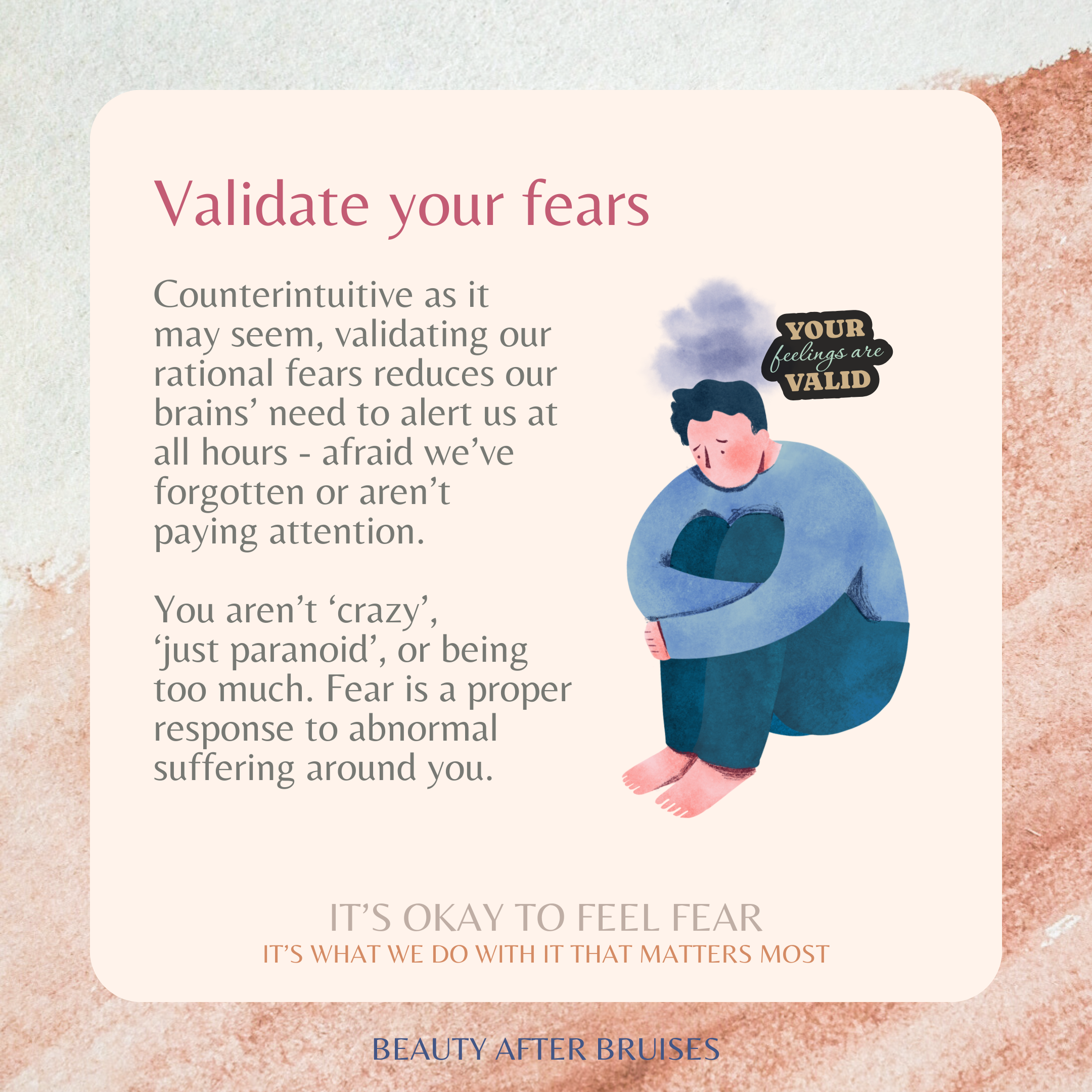
1. Validate your fears

Counterintuitive as it may seem, validating our rational fears reduces our brains’ need to keep alerting us at all hours - afraid we’ve forgotten or are no longer paying attention. It is healthy to acknowledge that you have every right to feel afraid—to feel lost, overwhelmed, or even distrustful of your surroundings. You are just trying to make sense of circumstances with no blueprint or, seemingly, any ready solutions. You aren't ‘crazy,’ ‘just paranoid,’ being ‘too much,’ or irrational.

On the right side of the image, there is an illustration of a person sitting with their knees drawn up, appearing to be in distress or deep thought. A thought bubble above their head contains the text "YOUR feelings are VALID."

People are suffering. Tensions are high. Any normalcy we once knew is rapidly shifting or has maybe even evaporated by now. It is normal to feel uneasy, to ask questions, to feel inconsolable, or be unable to look away. You aren't wrong; these situations are wrong. We weren't built to cope with this much human suffering all at once. You are having a normal reaction to many abnormal situations - some that may even mirror events or emotional periods of your past.

Instead of fighting your mind or invalidating yourself, we can actually take pause to thank your brain for doing its job to protect you. It’s done a valuable service. But, now, we can let it know that it’s okay to rest and trust you’ve not forgotten. You’re staying vigilant. You’ve got this. And, your remaining awareness will be better served elsewhere.

2. Find your footing

We protect ourselves and those around us best when we are our most present, alert, and stabilized selves. No one is effective in a state of panic, unmanaged dissociation, or hopeless paralysis. It’s okay to slowly step back into your body. Take the first breath you’ve drawn in for far too long. Shake out the frenetic, electrified anxieties coursing through your limbs. Release your jaw. Feel fresh blood fill your cells and rejuvenate you.

To face these global crises, we need access to all of our faculties. And, we can all benefit from the occasional time-out. To just pause. Re-center. Come up for air.

The image depicts a human brain surrounded by colorful flowers and leaves.

Our bodies also cannot take all this on without getting sick, either. We don’t want to make them a casualty of our self-sacrifice or passionate commitments to others. We need to be our best, strongest selves - rooted, alert, grounded, and healthy.

Ask yourself what do you need? Release what is no longer helpful. Find this present moment. Lift your chest. Look up and around you. Feel your sense of security and competence return. You are in control. You are no longer just along for the ride. You are competent and able.


3. Seek the good

When every direction we look holds a sea of tragedy, with no seeming end in sight, it’s easy to pick up a pair of morose-colored glasses. These impressive lenses scan and magnify the suffering for us. In response, we have to be intentional about seeking out the hope, the joy, and the good-ness. It is out there - including that in our own lives.

The image is a stylized illustration depicting a person with teal-colored hair and closed eyes. A brain is shown at the top of her head, from which several yellow flowers with green stems and leaves are growing.

Keep a list of your wins and accomplishments; the meaningful moments, the things you’re grateful for, the nights you laughed to tears. Revisit it in times of pain. Step outside of the sophisticated, well-targeted doom-scroll and search for the laughter, the rescues, the positive policy changes, recovery journeys, reunifications, and evidence of the Helpers. They’re out there. We promise.

No one can see in the dark. We all have to turn on a light to know where we're headed. And, holding onto hope does not invalidate or ignore suffering; it just gives us the chance to heal it.

4. BE the good

Few things immobilize us quite like traumatic helplessness. While we don’t believe everything happens for a reason, using our worry, empathy, hurt, and attention for good - to better the lives of another - is an opportunity to make meaning from otherwise senseless suffering.

The image depicts two individuals packing cans into a large cardboard box.

Help where you can. Show up with kindness, aid, resources, activism, or even just more love for the world. Call a friend. Compliment a stranger. Tell those you love that you love them. Be of service. Donate where you are able. Share and volunteer for relief efforts. Send a thoughtful text. Give a neighbor a smile or laugh.

Make the days brighter for someone in ways you wish your own could be lifted. You'll often find you feel lighter for it and, in effect, bring incontrovertible evidence to those in need that there is good in the world. You. And everyone else like you. Be the Good.


✧ ✧ ✧

We know these few things are somewhat simplistic, but they can truly be a stabilizing force when things have become all-consuming. But, before we go, as a bonus number five - anything you can do with and for a body in duress is a victory. Get it out. Shake that stress and panic out through your fingertips. Rock, move, dance, sway, stim, shake; yell, hum, sing, groan, scream it out. Replenish with sleep, a healing shower, your medications, and a good, nourishing meal. You need and deserve fuel to get through these tough times.

This image shows various BAB resources for self care.

Gift yourself the permission to care for yourself. And, if you need any other mental health resources, please do refer to the list included below:

✧ ✧ ✧


Please know that our hearts, minds, resources, and actions are with the countless communities in disrepair. …as well as with the first-responder and crisis-relief crews out protecting the vulnerable, those who’ve survived similar things in the past, and anyone left to stand by helplessly. We see you. We are here for you. The trauma care you may need now or long after exists, and we are eager to help you secure it. You deserve no less. We are sending all we can to lighten your burden.

Sending strength, solidarity, and solace,
🌻 The BAB Team


MORE POSTS YOU MAY FIND HELPFUL:

  ✧  Grounding 101: 101 Grounding Techniques
  ✧  Distraction 101: 101 Distraction Tools
  ✧  Flashbacks 101: 4 Tools to Cope with Flashbacks
Self-Care 101: 101 Self-Care Tools
  ✧  Nighttime 101 and Nighttime 201Sleep Strategies for Complex PTSD
Color Breathing 101: How to Calm Overwhelming Emotions and Physical Pain
  ✧  Imagery 101Healing Pool and Healing Light
  ✧  DID MythsDispelling Common Misconceptions about Dissociative Identity Disorder
  ✧  Modulation 101: Using Dials to Modulate Intrusive Mental Health Symptoms
 
  ❖  
Article Index  ❖


FIND US ON SOCIAL MEDIA:

  ✦  Facebook: Beauty After Bruises // Therapy Box Project
  ✦  Instagram: Beauty After Bruises // Therapy Box Project
  ✦  Threads
  ✦  Twitter/X

Modulating Intrusive Mental Health Symptoms

Whether you are struggling with overwhelming emotions, racing thoughts, intrusive images, panic attacks, self-harm urges, flashbacks, physical pain, or just so much clutter in your head it's hard to think, turning to the skill of modulation can be one way to drop your anchor amidst a raging sea. Incorporating dials, specifically, into your mental imagery can take things one step further and put you in control of the very sea itself.


But, first things first! What is imagery?!

Imagery is a symptom management technique that uses the act of bringing images to mind - in a very vivid, intentional, and specific way - to improve our current circumstances. Typically, it aims to target a distressing symptom through creative means and bring it to a more manageable, peaceful place. To improve our chances of success, there are two important things we need to remember. First, we need to give ourselves the permission to commit fully to the process — truly believing that the things we're calling to mind are real, capable of making a difference, and as effective as we make them. …even when they seem silly or impossible. Second, as we begin to flesh out the scenery in our minds, we want to use as many of our senses as we’re able—bringing things into crisp, hyperrealistic detail, so much so you could almost reach out and touch it.


Okay! But, What is modulation?

Modulation is another coping tool that allows us to adjust the intensity of our experiences - capable of slowing things down or speeding them up, making things louder or softer, more crisp or blurrier, brighter or darker, more sensitive or completely numb. This can be incredibly helpful for any symptoms that feel out of our control or "too much". Modulation allows us to make careful, finely-tuned adjustments at our executive direction. It can be performed using physical objects, body movements, mental imagery, audio/musical input, or any combination of the above! (See our article on Color Breathing for another example!) Today, we're looking at modulation via imagery with dials.

With your mind's creativity as your only limit, there are infinite ways to incorporate dials into the wrangling of distressing symptoms. You can visualize ones that are attached to other objects - like the tuning and volume knobs of a radio that’s blaring the scratchy static, negative self-talk, or distressing sounds of a trauma into your skull. Or, you can imagine the knobs of a video projector - one that’s playing your flashbacks or the intrusive images you don't want to see up on a screen.

See the scene clearly in your mind's eye.
Watch yourself slowly turn the knobs - noticing the effect each one has on the clarity, pace of the audio or flickering images, and volume; the distortion of quality, amount of competing background noise, and ability to identify who is in it.
Keep turning them until you've made it unrecognizable - shrunk the images off-screen, cut the audio to a low hum, or created total silence.
Now, keep turning the knob until you hear - and feel - that satisfying CLICK into the off position.
Feel the relief wash over you.
Notice the silence.
Take a look at the blackened screens before you. Feel free to stand in the peaceful nothingness OR even turn different knobs to put pleasing imagery in its place—your favorite song, a slideshow of your safest places or loving pets, a silly gif, comedian to spark a laugh, or the sound of a reassuring mantra that keeps you rooted in today. Confident. Calm. In control.

You can also create dials that have never existed before. Realism can go out the window with imagery! So long as you believe it is capable of the tasks you've assigned, it's got you covered! Imagine instead a set of unique, customized knobs that are attached to any limbs currently in pain - ones you can turn any time you need relief. Or, escape to the cogs and gear systems right inside your mind, just behind your eyes. Dials on your temples could slow down internal noise or thoughts that are coming too fast. A pressure gauge and release valve could let out pressure that's built up in your skull - great for intense headaches, anxiety, and various chronic illnesses.

You can also combine imagery with physicality to amplify its physiologic impact. Perhaps, you could install a speedometer gauge on your chest, one that's connected to any time you 'pump the brakes' with your foot. This could be used to help slow down intense emotions, bring to a halt any unsafe impulses that were building up in your body, or just simply slow your panicked, racing heart. Adding in the tactile, and grounding, physical action of pushing your foot into the ground to ‘press the brake pedal' can amplify this strategy's effectiveness. You can also use pedals and odometers to rev things up, too - be it to amplify emotions if you've been too numb, increase the amount of pain relief you’re sending to hurting areas of the body, or boost the flow rate of positive self-talk, hope, or patience you may need. The same can be helpful just before scary tasks that may require difficult-to-access resources like motivation, confidence, or bravery.

Knobs lain out on a control panel within your body - like just behind your eyes or ears - can also distort the clarity of disturbing images, minimize them away from sight, turn off the flickering feature of a flashback, or swipe them out of the way completely. You could also place dials on body parts known for self-harm. While you may not feel ‘allowed' to turn some urges off entirely, you could spin the impulse through a color wheel gradient instead (after assigning colors to its intensity or type). You could also add buttons that release cold or warm sensations to the area under attack, numbing agents that would neutralize the "benefit" of any harm done to it anyway, or a surplus of TLC to any part of the body whose urges have already gone too far into the red. Similar options to these - like salves, anesthetics, relaxants, etc - can be employed for chronic pain, various disabilities, and acute injuries as well! Imagery and modulation skills can bring real relief to more than just psychological distress.

There are so many options at your fingertips when it comes to modulation and imagery. Get creative! (But, we do want to acknowledge that for some it just doesn’t come naturally. We also have a forthcoming article for those who have aphantasia or who just can’t quite get the hang of it!) Consider trying out multi-sensory knobs, like the ridged old TV knobs that make a hard, satisfying thunk when they're off. Or, experiment with more recent tech dials instead. Try out laptops or earbuds that make quieting tones each time you tap the volume down, or note the key clacking as you send information required to make factory machines and cogs move. The dials could also be futuristic, bio-mechanical, or involve android parts - things no one's ever seen! The important thing is that it feels accurate and beneficial to you and your symptoms. When it comes to reducing suffering, as well as adding more color to our lives, whatever works best for YOU is always the right choice.

We hope you feel a little freer to explore some new ways of managing your unruly symptoms as well as making the joy a little louder! Our minds are more powerful than we often give them credit, and we want to be sure you are armed with a tool belt as vast as you are.

Please feel free to share your ideas with others below! Your personal go-to hack for your most stubborn symptoms may be someone else's magic trick solution! Good luck, and as always, know that we're right here should you have any questions or need some fresh ideas!

Happy dialing!

MORE POSTS YOU MAY FIND HELPFUL:

  ✧  Grounding 101: 101 Grounding Techniques
  ✧  Distraction 101: 101 Distraction Tools
  ✧  Flashbacks 101: 4 Tools to Cope with Flashbacks
Self-Care 101: 101 Self-Care Tools
  ✧  Nighttime 101 and Nighttime 201Sleep Strategies for Complex PTSD
Color Breathing 101: How to Calm Overwhelming Emotions and Physical Pain
  ✧  Imagery 101Healing Pool and Healing Light
  ✧  DID MythsDispelling Common Misconceptions about Dissociative Identity Disorder
  ✧  Trauma and Attachment: 3-Part Series on Attachment Theory with Jade Miller
 
  ❖  
Article Index  ❖


FIND US ON SOCIAL MEDIA:

  ✦  Facebook
  ✦  Instagram
  ✦  Twitter

Color Breathing 101

The image displays the text "Coping Skill of the Day" at the top, followed by "color breathing" at the bottom. These words are set against an abstract, colorful background.

What is color breathing?


Color breathing is a coping skill that combines a little mental imagery with intentional breathing to help modulate intense feelings, stabilize panic, soothe pain, slow rapid thoughts, or even get you more grounded. It's an invaluable tool that truly everyone can use, but it's especially beneficial for those who struggle with emotion dysregulation, flashbacks, dissociation, and more. So, how do you do it?!

There are many ways to use color breathing, so not only is customization the fun part but it's also the key to its success! One of the most common ways folks practice it is to first imagine a very calming color (perhaps cooling deep blues or purples, or warming yellows and golds for others). Then assign a color that matches the upsetting or painful emotions/sensations you're experiencing - perhaps reds, oranges, or blacks.
Slowly inhale the calming shade deep into your lungs. Watch it effortlessly locate all the areas of unrest, anxiety, or pain inside of you. See it just as easily envelope them, soothe them, heal them. As the color you see representing your distress gets extracted from every cell, space that it invaded, or place it radiated off of you, begin your exhale. Watch that color, in all of its shapes and textures, leave you through as long a breath as you can manage. It may leave in a rush, like it was almost expelled from your chest, or instead find itself slow and difficult to release as you contend with its resistance.

Repeat this deep inhaling and exhaling of colors until you feel more at ease. You may even find that the colors change a bit as you start to improve - with reds dialing back to oranges then yellows, its jagged edges softening. Or instead see black tarry sludge becoming thinner, lighter, and easier to lift out. This version is most commonly used for anxiety, panic attacks, anger or budding rage, and physical pain. But, some find it helpful for all overwhelming (or dysregulated) emotions - like grief, sadness, embarrassment, shame, or even apathy and numbness - similarly opting to inhale invigorating, light colors and exhale the weighted colors of misery, loneliness, or guilt.

 
The image depicts two butterflies rendered in a watercolor style.

Another method is to concentrate mostly on the exhale—inhaling any clear, healing breath, and with each exhale of the negative feelings, watch the colors change like a gradient. Shifting from bright fiery shades to cooler tones, or from dark, fully-opaque colors to light, whimsy translucence. This is particularly useful if you haven't been able to identify which feelings you're experiencing or have no idea "what you need" to make things better. You just know that what you're dealing with is intense and you want it out of you. Quickly. So, instead, put all your energy into exhaling any highly active colors until you either get to the calmer end of the 'rainbow'. Maybe can’t even see your breath at all. This can be a really effective way to still dial things down. (You can also dial up, and use quicker breaths, if you need the reverse to combat numbness!)

There are many, many other ways to customize this tool to work best for you. The more you can truly visualize the practice and believe in its effectiveness, the more successful it will be - physiologically! There are also countless ways to apply this template beyond colors alone. Incorporate speeds for racing thoughts or your pounding heart rate that needs stilled and quieted. Bring in different textures, medicinal properties, magic or fantasy elements, sounds, or physical gestures to go along with the flow of your breath. Fully connect with your body and be active in shifting what it is experiencing. Help yourself feel more in control—owning your emotions, your body, and your healing.

 
The image depicts two butterflies rendered in a watercolor style.

For those who are not naturally inclined toward creative imagery, have aphantasia, or don't yet know what to assign their internal experiences, holding physical objects - like color wheels/dials you've made for yourself or colorful photos you like or have on your phone - can be helpful. You can use them as both a visual reference as well as a tool you can manually change - matching it to the color you either just achieved, are aiming to get to next, or need to pull from in your current inhale. These are great ways to make this technique more accessible to you. Modify it to be exactly what you benefit from most!

How would you go about color breathing?
Sharing new ideas, suggestions, or personal experiences - especially from other survivors -
can often be just the thing that makes new techniques click for someone else!

Happy, easier breathing!


MORE POSTS YOU MAY FIND HELPFUL:

  ✧  Grounding 101: 101 Grounding Techniques
  ✧  Distraction 101: 101 Distraction Tools
  ✧  Flashbacks 101: 4 Tools to Cope with Flashbacks
Self-Care 101: 101 Self-Care Tools
  ✧  Nighttime 101 and Nighttime 201Sleep Strategies for Complex PTSD
Color Breathing 101: How to Calm Overwhelming Emotions and Physical Pain
  ✧  Imagery 101Healing Pool and Healing Light
  ✧  DID MythsDispelling Common Misconceptions about Dissociative Identity Disorder
  ✧  Did You Know?: 8 Things We Should All Know about C-PTSD and DID
  ✧  Trauma and Attachment: 3-Part Series on Attachment Theory with Jade Miller
 
  ❖  
Article Index  ❖


FIND US ON SOCIAL MEDIA:

  ✦  Facebook
  ✦  Instagram
  ✦  Twitter